
Lesson 10, Task 4: Making Predictions
30 seconds to prepare · 60 seconds to speak
What this task asks you to do
You see the same picture you just described in Task 3, but now you’re asked what will happen next.
That single word, next, is the whole task. And it’s where most candidates lose their marks.
The one mistake that defines this task
Students re-describe the picture instead of predicting.
It happens because the image is familiar, the pressure is on, and describing feels safe. But a Task 4 answer that describes the scene again scores badly no matter how good the English is, because it hasn’t fulfilled the task.
Everything in your answer must point forward in time. If a sentence could have appeared in your Task 3 answer, it doesn’t belong here.
❌ “There’s a man arranging fruit at a stall.” ✅ “The man arranging the fruit will probably finish setting up and start serving the queue that’s forming.”
How this task is scored
- Task fulfillment first. Are these genuinely predictions?
- Grounding. Predictions tied to something visible score higher than invented ones.
- Future and probability range. This task is a natural showcase for varied future structures, use several, not one.
The CLUE → CONSEQUENCE pattern
Every prediction has two halves. Name what you can see, then say what it will lead to.
Clue: “A queue is starting to form at the produce stall…” Consequence: “…so the vendor will most likely have to speed up and call someone over to help him.”
Repeat this three times, and you have a complete answer. It’s the simplest structure on the test, and the most reliable.
| Time | ||
|---|---|---|
| Opening line | Signal you’re predicting | ~5s |
| Prediction 1 | Clue → consequence | ~17s |
| Prediction 2 | Clue → consequence | ~17s |
| Prediction 3 | Clue → consequence | ~17s |
No conclusion is needed. Unlike almost every other task, you can simply finish on your final prediction. Don’t waste seconds on a wrap-up line, spend them on content.
Plug-and-play template
Template A, the standard
“Looking at what’s going on here, I can make a few reasonable predictions about the next little while.
Firstly, [visible clue], so [person] will almost certainly [prediction]. I’d expect [follow-on consequence], because [reason].
Secondly, [visible clue]. Judging by [evidence], I’d be surprised if [prediction] didn’t happen within [time frame].
Finally, given [clue], [prediction]. Before long, [further consequence], and I’d imagine [knock-on effect].”
Template B, the short-term / long-term variant
A useful alternative when the image doesn’t give you three separate clues.
“Based on what I can see, a few things are likely to unfold here.
In the immediate future, [clue] means [person] is bound to [prediction].
A little later on, I’d expect [prediction 2], simply because [reason].
And looking further ahead, there’s a good chance that [longer-term prediction]: [reason]. It wouldn’t surprise me if [speculative extra].”
Future and probability language
Rotate through these constantly. Using four or more distinct structures is a direct scoring win.
High probability
- “…will almost certainly…”
- “…is bound to…”
- “…is definitely going to…”
- “I’d be very surprised if they didn’t…”
- “There’s little doubt that…”
- “…is all but guaranteed to…”
Medium probability
- “…will most likely…”
- “…is probably going to…”
- “There’s a good chance that…”
- “I’d expect them to…”
- “…in all likelihood…”
- “The odds are that…”
- “I’d imagine…”
Lower / speculative
- “…might well…”
- “It wouldn’t surprise me if…”
- “There’s a possibility that…”
- “…could conceivably…”
- “I suppose it’s possible that…”
- “…may end up…”
Linking a clue to a consequence
- “Given that [clue], I’d expect…”
- “Judging by [clue], …”
- “[Clue], so naturally…”
- “Since [clue], it follows that…”
- “The fact that [clue] suggests…”
- “Because [clue], they’re going to have to…”
Time framing
- in the next few minutes · shortly · before long · within the hour · by the end of the day · any moment now · a little later on · in the next little while · sooner rather than later
Sequencing your three predictions
| Position | Options |
|---|---|
| First | ”Firstly…” · “To start with…” · “The most obvious thing is…” |
| Second | ”Secondly…” · “On top of that…” · “Another thing that’s likely…” |
| Third | ”Finally…” · “And looking a bit further ahead…” · “Lastly, I’d say…” |
Fresh phrasing beats literal phrasing
| Instead of | Say |
|---|---|
| they will fight | things may escalate, tempers could flare |
| he will be busy | he’ll have his hands full |
| it will get crowded | the crowd is only going to thicken |
| she will buy it | she’ll end up walking away with it |
| they will leave | they’ll be heading off before long |
| it will finish | it’ll be wrapping up shortly |
Model answer
Question: Look at the same picture. What do you think will happen next?
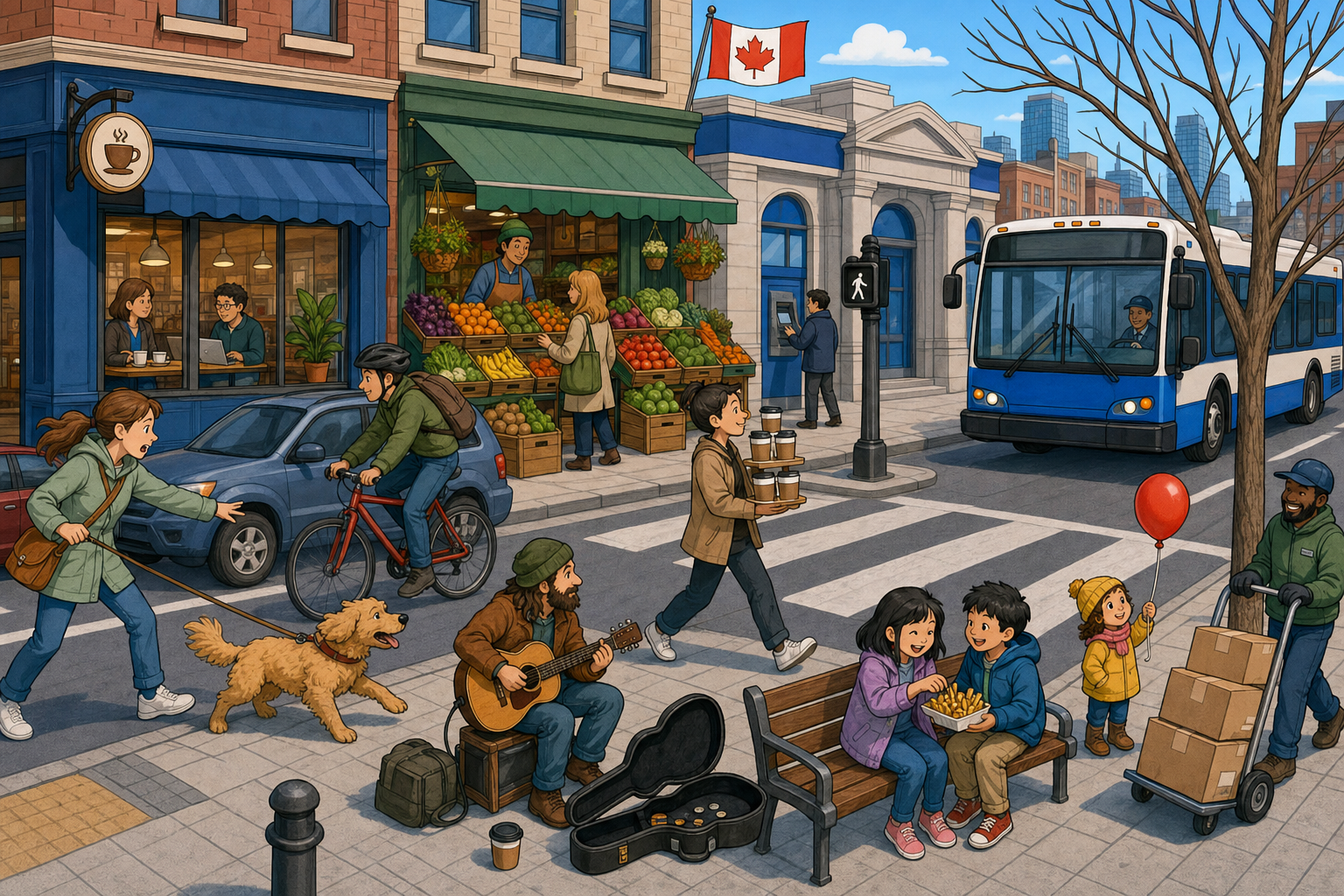
“Looking at what’s going on here, I can make a few reasonable predictions about the next little while.
Firstly, the small dog is straining hard against a slipping leash and its owner is only just reaching for it, so I’d expect the dog to break free within seconds and dart into the road. Given how close the red car is to the crosswalk, it’s very likely the owner is going to have a genuinely tense few moments getting him back.
Secondly, the boy in the backpack has just kicked his basketball across the crossing and is clearly about to chase it. Judging by the angle the ball is bouncing, he’s almost certainly going to end up in the middle of the road, and I’d be surprised if a driver doesn’t have to brake fairly sharply.
Finally, the elderly couple are only halfway across the intersection and everybody around them is moving quickly. I’d imagine one of the passers-by is probably going to slow down and offer a hand, or at least gesture for the cars to wait, because that corner is only going to get busier as the market sale draws more people in over the next few minutes.”
Why this scores well
- Every sentence points forward. Nothing is a re-description.
- Each prediction is grounded in a visible clue: the slipping leash, the bouncing ball, the elderly couple mid-cross.
- Six different probability structures: I’d expect, very likely, almost certainly, I’d be surprised if, I’d imagine, only going to. No repetition.
- Time framing throughout: the next little while, within seconds, a genuinely tense few moments, over the next few minutes.
- No conclusion: it uses the full time on content, exactly as the task allows.
- Complex structures: “I’d be surprised if a driver doesn’t have to brake…”
The same answer at Level 6, and how to fix it
“In the picture there is a street. There is a boy and he is running. The dog is going to the street. The old people are walking. Maybe the boy will catch the ball. Maybe the dog will go to the car. Maybe the old people will be safe. I think it will be a busy day.”
Rater’s diagnosis
| Issue | Score area | Why it costs you |
|---|---|---|
| First two sentences re-describe the scene | Task Fulfillment | This is the defining failure of Task 4, it isn’t a prediction |
| ”Maybe” three times | Vocabulary | One probability word repeated where the task exists to showcase several |
| Predictions floating free of any clue | Content/Coherence | ”The old people will be safe”, based on what? |
| Very short sentences, no subordination | Vocabulary | Caps near Level 8 |
| ”It will be a good day” | Content | Vague; not a prediction anyone could verify against the image |
| Likely finishes around 35 seconds | Task Fulfillment | Half the time unused |
Estimated level: 6.
The upgrade path
| Level 6 | Level 11 |
|---|---|
| ”In the picture there is a market and many people are buying vegetables.” | (Delete entirely, this belongs in Task 3.) Open instead: “Looking at what’s going on here, I can make a few reasonable predictions about the next little while." |
| "Maybe they will buy some vegetables." | "There’s clearly a queue starting to build at the produce stall, so the vendor will almost certainly have to pick up his pace." |
| "Maybe the child will get something." | "The small child tugging at his father’s sleeve is very obviously pointing at something he wants, I’d be surprised if the family didn’t stop to buy it within the next few minutes." |
| "Maybe more people will come later. The man will be busy." | "Given how soft the light still is, the crowd is only going to get denser as the morning goes on, and I’d imagine the fresh produce will sell out well before lunchtime.” |
The pattern: delete every description, anchor each prediction to a visible clue, and rotate your probability language.
Grammar watch-list for this task
Future forms are where this task bleeds marks:
| Watch for | ✗ | ✓ |
|---|---|---|
| “Will” + base verb | ”he will to help” / “he will helping" | "he will help" |
| "Going to” form | ”they going to leave" | "they’re going to leave” |
| Likely + to | ”it is likely happen" | "it is likely to happen” |
| Negative-conditional prediction | ”I’d be surprised if they don’t buy" | "I’d be surprised if they didn’t buy” |
| Continuous future | ”soon the crowd will getting bigger" | "soon the crowd will be getting bigger” |
Grade your own answer
- Zero re-description: test every sentence: could it have appeared in Task 3?
- Three separate predictions
- Each one anchored to a visible clue
- Four or more different probability structures
- Never used “maybe” more than once
- Two or more time-framing phrases (before long, within the hour)
- At least two complex sentences
- No conclusion wasting your final seconds
- Zero fillers
- Finished between 55 and 58 seconds
8+ ticks = Level 9 territory. All 10 = you’re competing for 11–12.
Three more sample answers
These use the same three scenes as the previous lesson. Read them alongside those descriptions and notice that nothing is repeated, every sentence moves forward in time.
Sample 2, the family kitchen
“Based on what I can see, a few things are likely to unfold over the next few minutes.
Firstly, whatever’s in that pan is clearly close to done, so the adult at the stove will almost certainly start calling everyone to the table shortly. I’d expect the groceries on the counter to stay exactly where they are until after dinner.
Secondly, the teenager laying the table is only half-focused on it. Judging by how attached they are to that phone, I’d be surprised if they didn’t get told to put it away within the next minute or two.
Finally, given that the youngest child is playing with kitchen equipment on the floor, there’s a very good chance someone’s about to trip over them, and I’d imagine they’ll be moved out of the way fairly briskly.”
Sample 3, the community park
“Looking at this, I can make a few reasonable predictions about how the afternoon will go.
To start with, that queue at the ice cream van is only going to grow, it’s warm, it’s the middle of the afternoon, and more families keep arriving. I’d expect the van to be doing steady business for at least another hour.
On top of that, the dog chasing the ball is heading straight towards the picnic blankets. It wouldn’t surprise me at all if it ran through somebody’s lunch in the next few seconds.
And looking a bit further ahead, given how low and golden the light already is, the families will most likely start packing up before long, and I’d imagine the football game will carry on well after everyone else has gone home.”
Sample 4, the office meeting
“There are a few things I’d expect to happen next here.
Firstly, the colleague with folded arms very obviously disagrees with what’s being presented, so I’d say it’s almost inevitable that they’ll interrupt or raise an objection within the next minute.
Secondly, the presenter is nearly out of whiteboard space. Since she’s clearly not finished, she’ll probably have to stop and rub something out, which tends to break the flow of a meeting like this.
Finally, given how untouched those biscuits are and how full the coffee cups still look, I’d guess this meeting started only recently, so in all likelihood it’s going to run considerably longer than anyone in that room is hoping.”
Notice across all three: no description, every prediction hangs off something visible, probability language rotates constantly, and none of them waste time on a conclusion.
Common mistakes
| Mistake | Fix |
|---|---|
| Re-describing the picture | Every sentence must be future-facing. Test each one: could it have been in Task 3? |
| Predictions with no visible basis | Anchor each one to a clue: “given that…, I’d expect…” |
| Repeating “likely” four times | Rotate through the probability bank above |
| Wasting 10 seconds on a conclusion | You don’t need one here. Use the time for a fourth prediction. |
| Predicting something wildly implausible | It doesn’t need to be realistic, but grounded predictions are easier to phrase well |
| Running short | Three clue→consequence pairs fills 60 seconds naturally. Plan all three in prep. |
Your practice
Open one set on Celpora and put today’s lesson to work.
Practice Task 4: Making Predictions. 30s prep · 60s speaking · AI feedback