Lesson 14, Task 8: Describing an Unusual Situation
30 seconds to prepare · 60 seconds to speak
What this task asks you to do
You’re shown something strange, an odd object, a bizarre scene, an unfamiliar contraption, and you have to describe it to someone who cannot see it, usually because you want them to help, advise, or react.
It’s the last task on the test, and the one with no reliable template. That’s not a gap in your preparation; it’s the nature of the task. The image is deliberately unpredictable, so a memorized script can’t fit it.
Which means the skill this lesson trains isn’t memorisation. It’s improvising inside a structure: and staying confident when the vocabulary runs out.
The mindset shift that unlocks this task
Most people lose marks here for one reason: they freeze when they don’t know a word.
Here’s what almost nobody realizes: you are not expected to know it. The images are chosen to be unfamiliar. Raters are not testing your knowledge of obscure objects, they’re testing whether you can describe something in English when the obvious noun isn’t available.
So say so, naturally, and describe it anyway:
“I honestly don’t know what you’d call this part, it’s the section just below the handle, but it’s covered in these small ridged grooves.”
That sentence scores better than silence, and better than a wrong guess stated as fact. A small natural laugh or an aside (“this is going to sound ridiculous, but…”) reads as confident and native-like, not unprofessional.
Freezing is the only real failure here. Keep talking.
The WHERE → WHAT → WANT pattern
| Time | ||
|---|---|---|
| WHERE | Where you are and how you came across it | ~12s |
| WHAT | What’s unusual about it, the bulk of your answer | ~35s |
| WANT | What you’d like the listener to do | ~10s |
Your fallback checklist when the noun escapes you
When you can’t name something, describe it along these six dimensions. You will always be able to say something about each:
- Size: “roughly the size of a shoebox”
- Shape: “vaguely cylindrical, tapering at one end”
- Color: “a dull copper color, quite tarnished”
- Material: “it looks like some kind of moulded plastic”
- Position: “it’s mounted on the wall, about head height”
- Function: “as far as I can tell, it’s meant to hold something”
Run through three or four of these and you’ve filled 30 seconds without ever naming the object.
Vocabulary: don’t repeat “different”
This task invites strong adjectives more than any other. The trap is reaching for the same neutral word repeatedly.
| Instead of | Reach for |
|---|---|
| different | various, contrasting, distinct |
| weird | bizarre, peculiar, striking, odd-looking |
| big | substantial, oversized |
| shiny | glossy, polished, gleaming |
| old | worn, weathered, tarnished |
Model answer
Question: While visiting a recreation center, you watch a group of people playing a sport you have never seen before. Call your friend Daniel and describe in detail what the sport is like and what each player is doing. Ask him whether he would like to try it together sometime.
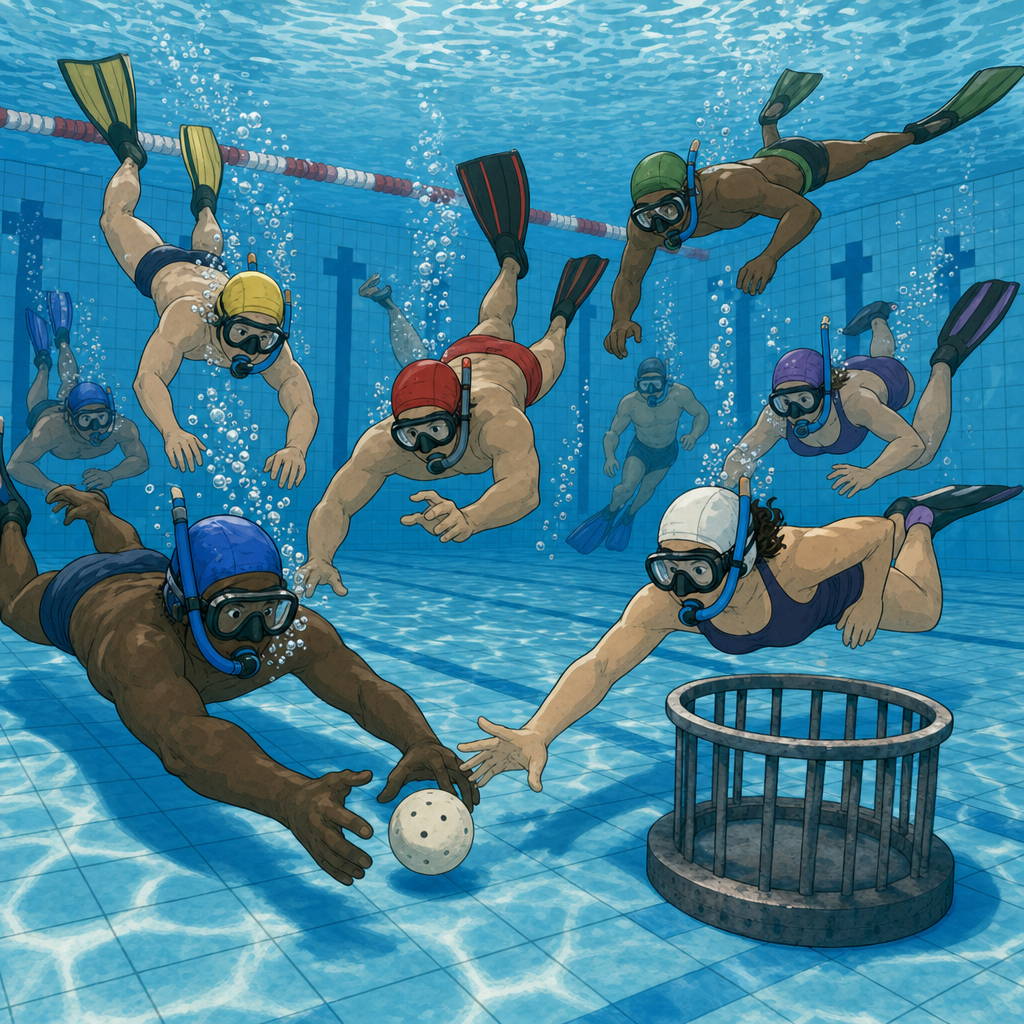
“Hey Daniel, I’m at that new recreation center on Front Street, and I’ve just come across the most bizarre sport I’ve ever seen, in a swimming pool of all places, so I need you to tell me if you’ve ever heard of it.
Setting-wise, it’s in a full-sized community pool, and there are about six or seven people in the water. They’re all wearing swim caps in different colors, presumably to mark two teams, plus diving masks and snorkels, and every one of them has full fins on their feet.
Here’s the odd part. They’re not doing lengths, they’re diving straight down to the tiled floor of the pool. Down there I can just about make out some sort of heavy object, it looks like a small metal disc or maybe a puck, and two players are wrestling for it with their hands while a third circles behind them. Bubbles are streaming up from every direction, so I honestly can’t quite tell what the rules are, but it’s clearly some kind of team game, and it looks physically exhausting.
The lifeguard reckons it’s called underwater rugby, though I’m not entirely convinced, from what I’m watching it might be something more like underwater hockey.
Anyway, you’ve tried practically every sport going. Do you reckon we should sign up for a trial session together, or does this look more painful than fun from what I’m describing?”
Why this scores well
- Follows WHERE → WHAT → WANT cleanly, ending with a genuine invitation.
- Admits the vocabulary gap naturally: “some sort of heavy object,” “it might be…”, confident, then keeps going.
- Uses the fallback palette: setting, number of people, equipment, actions, object, function, all covered.
- Rich, varied adjectives: bizarre, full-sized, tiled, heavy, physically exhausting. No word repeated.
- A natural, conversational register with a light touch at the end, sounds like a real person, not a script.
- Complex structures: “a third circles behind them,” “does this look more painful than fun.”
The same answer at Level 6, and how to fix it
“Hi Daniel. I am in a pool. I see a sport. It is very strange. It is… um… I don’t know the name. People are in the water. They wear masks. They have fins. They go down to the bottom. There is a thing. They fight for it. It is very different. I don’t know what it is. Um… Sorry. Do you know? Bye.”
Rater’s diagnosis
| Issue | Score area | Why it costs you |
|---|---|---|
| Long silences after “I don’t know” | Listenability | Freezing is the defining failure of Task 8, the pause itself is the error, not the missing word |
| ”different” four times | Vocabulary | The exact repetition this task is designed to expose |
| ”a thing,” “a different part” | Vocabulary | No attempt at size, shape, color, material, or function |
| ”Sorry” for not knowing | Listenability | Apologizing signals a lack of confidence; the source is clear you’re not expected to know it |
| No clear request | Task Fulfillment | ”Maybe you know it” isn’t asking for anything specific |
| Likely finishes around 30 seconds | Task Fulfillment | Half the time unused |
Estimated level: 5–6.
The upgrade path
| Level 6 | Level 11 |
|---|---|
| ”I am in a market. I see a thing." | "Hey Daniel, I’m at that vintage market on Wellington Street, and I’ve just come across the strangest object. I genuinely have no idea what it is, so I need a second opinion." |
| "It is… um… I don’t know the name. [pause]" | "I don’t know what you’d actually call it, but it’s roughly the size of a small kettle, vaguely cylindrical, tapering towards the top almost like a bell." |
| "It is made of metal. It is different." | "The whole thing’s made of some kind of tarnished brass, quite weathered, with these distinct engraved patterns running around the base." |
| "It has a different part on the side." | "There’s a small hinged flap on one side, and underneath there’s a compartment with three separate chambers: each a slightly different depth, which strikes me as deliberate rather than decorative." |
| "I don’t know what it is. Um… Sorry. Maybe you know it. Bye." | "The vendor reckons it’s an antique spice container, but I’m not convinced. Do you reckon it’s worth the ninety dollars he’s asking, or am I about to buy an expensive piece of junk?” |
The pattern: say you don’t know the word and keep talking. Then run the fallback checklist, size, shape, color, material, position, function, and finish with a real request.
Grammar watch-list for this task
| Watch for | ✗ | ✓ |
|---|---|---|
| “Look like” vs “look" | "it looks like strange" | "it looks strange” / “it looks like a bell" |
| "Made of” vs “made from" | "made by metal" | "made of metal" |
| "Kind of / sort of” + singular | ”some kind of metals" | "some kind of metal” |
| Relative clauses | ”there is a flap, which it opens" | "there’s a flap which opens” |
| Comparative “as… as" | "it is big as a kettle" | "it’s about as big as a kettle” |
| Position prepositions | ”in the side,” “on the top of" | "on the side,” “at the top” |
Grade your own answer
- Said where you are before describing the object
- Named the vocabulary gap and kept going: no apology, no freeze
- No silence longer than two seconds
- Used four or more of the six fallback dimensions (size, shape, color, material, position, function)
- Six or more distinct adjectives
- Never said “different” or “weird” more than once
- Hedged any guess about what it is (“some sort of…”)
- Ended with a specific request to the listener
- At least two complex sentences
- Finished between 55 and 58 seconds
8+ ticks = Level 9 territory. All 10 = you’re competing for 11–12.
Plug-and-play template
There’s no template that fits every image, but this skeleton flexes to almost any object, which is the next best thing.
Template A, the unfamiliar object
“Hey [name], I’m at [location] and I’ve just come across the strangest [thing]. I genuinely have no idea what it is, so I need a second opinion.
It’s [where it is / how you found it]. It’s roughly the size of [everyday comparison], but it’s shaped [shape description], almost like [loose comparison]. The whole thing’s made of [material], [condition adjective], with [distinguishing feature].
Here’s the bit I can’t work out. There’s [unusual feature]. I don’t know what you’d actually call it, and [further detail]. [Your observation about what it might do].
[Someone] reckons it’s [a guess], but honestly, I’m not convinced, [why not].
Anyway, [your request]?”
Template B, the unusual situation or scene
Use when the question shows an odd event rather than an odd object.
“[Name], you’re not going to believe what I’m looking at. I’m [where], and [the strange thing that’s happening].
Let me try to describe it. [Who’s involved] and [what they’re doing]. The odd part is [what makes it unusual]: [detail].
I’ve no idea what’s going on, honestly. It could be [possible explanation 1], or possibly [explanation 2], but neither really adds up because [reason].
Everyone around me seems [reaction], which makes it even stranger.
[Your request, should I stay / do you know what this is / what would you do?]”
Three more sample answers
Watch how each one names the vocabulary gap out loud and simply keeps going.
Sample 2, the laundromat machine
“Hey Nadia, quick question, I’m in the laundry room downstairs and there’s a machine here I’ve genuinely never seen before, and I can’t work out what it does.
It’s about waist height, roughly the size of a small dishwasher, and it’s a sort of pale industrial gray. It’s got a round door on the front like a dryer, but the inside is completely flat rather than a drum, which is the bit confusing me.
On the top there’s a row of, I don’t know what you’d call them, dials I suppose, with symbols rather than words. One looks vaguely like a shirt and another might be a snowflake. There’s also a coin slot on the side, so it clearly costs something.
Any idea what I’m actually looking at? I don’t want to feed it two dollars and destroy a jumper.”
Sample 3, the sculpture in the park
“Ravi, you’re not going to believe what’s appeared in Wellington Park overnight.
There’s a sculpture where the flowerbed used to be, and honestly nobody seems to know what it’s meant to be. It’s enormous, maybe three meters tall, and it’s made of some kind of weathered steel, quite rusted in places, though I think that might be deliberate.
The shape is the strange part. It’s a series of curved plates that twist around each other going upwards, a bit like a spiral staircase with no steps. There’s a gap through the middle that you can actually see the sky through.
There’s a small plaque at the base but the text is too worn to read from where I’m standing.
Opinion is fairly divided among the people looking at it. What do you reckon, is it art or did someone lose a bet?”
Sample 4, the unusual gift
“Hi love, I’ve opened the parcel from your aunt and I’m completely stumped.
It’s a wooden object, roughly the size of a shoebox, and beautifully made, polished, quite dark, possibly walnut. The top slides off, which I only discovered by accident.
Inside there are six compartments of noticeably different sizes, each lined with a soft green fabric. Two of them are long and narrow, and the rest are square. There’s also a little brass hook on the underside of the lid, which strikes me as deliberate rather than decorative.
My best guess is that it’s meant to hold something specific, cutlery, or perhaps some sort of instrument, but honestly I’m guessing.
Could you ask her what it’s for? I’d rather find out now than display it upside down for a year.”
Notice across all three: each admits the gap without apologizing, runs through size, shape, material, position and function, avoids repeating “different” or “weird,” and closes with a genuine request.
Common mistakes
| Mistake | Fix |
|---|---|
| Freezing when a word won’t come | Say you don’t know it and describe it anyway |
| Guessing a name and stating it as fact | Hedge: “some sort of…”, “what I’d guess is…” |
| Repeating “different” or “weird” | Rotate the adjective table above |
| Describing only the object, never the setting | Start with WHERE, it grounds the listener |
| Forgetting to make a request | The listener needs to know what you want from them |
| Long silences while thinking | A short pause is fine; ten seconds is not. Keep describing. |
Your practice
Open one set on Celpora and put today’s lesson to work.
Practice Task 8: Unusual Situation. 30s prep · 60s speaking · AI feedback