
Lesson 9, Task 3: Describing a Scene
30 seconds to prepare · 60 seconds to speak
What this task asks you to do
You’re shown a picture and asked to describe it to someone who cannot see it. That framing matters: your listener has no idea what’s in front of you, so vagueness is useless to them and to the rater.
This is the most mechanical task on the test, which is good news. There’s no opinion to form, no argument to build. You just need a reliable order to move through the image and enough descriptive vocabulary to fill 60 seconds.
How this task is scored
- Coverage and order. Wandering randomly around the picture reads as disorganised. A consistent path reads as controlled.
- Descriptive range. This is the single best task on the test for scoring adjectives and adverbs. Raters expect a lot of them here.
- Accuracy vs. inference. Stating a guess as a fact is an error. Hedging it correctly is a scoring opportunity.
The WIDE → CLOSE → CAREFUL frame
| Time | ||
|---|---|---|
| WIDE | An overview of the whole scene | ~10s |
| CLOSE | Three focused details, people, objects, actions | ~40s |
| CAREFUL | One sensible inference, properly hedged | ~10s |
WIDE, set the scene in one sentence
Say what kind of place it is and what’s generally happening. Don’t start with a small detail.
“The image shows what appears to be a busy outdoor market, most likely on a weekend morning.”
CLOSE, three details, using foreground and background
The easiest reliable structure inside the middle section is foreground → background, because it gives you a built-in order and a natural transition.
For each detail, mention the people, what they’re doing, and one descriptive feature. Actions are what students most often skip, a picture is not just a list of objects.
CAREFUL, one inference, hedged
Finish with something you can reasonably conclude, marked clearly as a guess.
“Judging by how relaxed everyone looks, I’d say this is a regular weekend routine rather than a special event.”
Hedging language, and why variety matters
Anything you can’t literally see must be hedged. But here’s the trap: most students find one hedge word and repeat it five times. Saying “likely” five times is a visible vocabulary ceiling.
Rotate these:
- it appears that…
- seemingly…
- presumably…
- it looks as though…
- I’d guess that…
- most probably…
- judging by…, I’d say…
Same with your openers. Don’t say “the picture” five times:
the image · the scene · what’s shown here · what’s portrayed · this photograph
Model answer
Question: Describe the scene in this picture to someone who cannot see it.
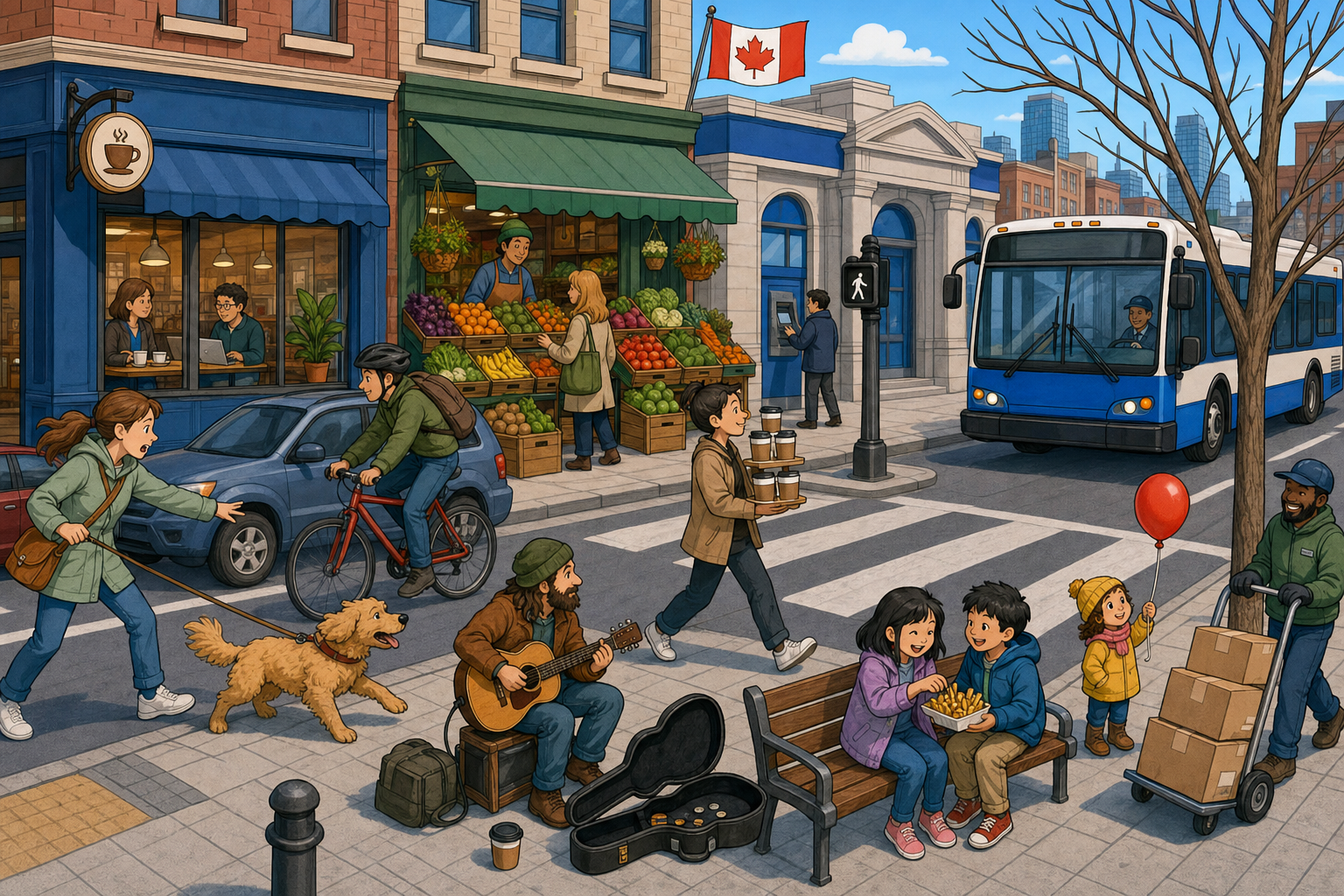
“The image shows what appears to be a busy Canadian downtown street corner at a pedestrian crosswalk, most likely on a weekend afternoon judging by how much is going on.
In the foreground, several people are moving through the crosswalk at once. A teenager in a red hoodie is dashing across looking at his phone, and a young boy with a backpack has clearly just kicked an orange basketball, which is bouncing away from him further down the crossing. Nearby, two kids in the corner are sitting close together on a low bench under a bare tree with a bright red balloon caught in the branches.
Slightly further back, an older man and woman are stepping carefully off the curb hand in hand, both leaning on walking canes, while a man in a bike helmet reaches out to grab a small dog whose leash has slipped and is straining toward the road. A shiny red car sits parked half into the road behind them, with a paper coffee cup toppled next to the fire hydrant.
In the background, three storefronts line the sidewalk, a coffee shop with a small cup sign, a fruit-and-vegetable market advertising a fifty-percent-off sale, and a bank on the corner. There’s a crate of apples out front of the market.
Judging by the light jackets everybody’s wearing and the pace, I’d say it’s probably early autumn, and this particular corner is clearly livelier than usual.”
Why this scores well
- Clear spatial order: foreground → middle → background → inference. Nothing wanders.
- People, objects, and actions in every section, dashing, kicking, sitting, stepping, reaching, straining, advertising.
- Dense descriptive language: busy, bright, bare, shiny, toppled, livelier.
- Varied hedging: appears, most likely, clearly, presumably, judging by, five different structures, no repetition.
- Varied openers: “the image,” “several people are,” “I’d say.”
- One clean inference at the end, correctly marked as a guess.
The same answer at Level 6, and how to fix it
“In this picture I can see a market. There are many people. There is a man and he is selling vegetables. He is old. There are tomatoes and other vegetables. In the picture there is also a family. They are shopping. In the picture I can see many shops behind. The weather is good. The people are happy. That’s all I can see in the picture.”
Rater’s diagnosis
| Issue | Score area | Why it costs you |
|---|---|---|
| ”picture” five times | Vocabulary | The clearest possible signal of limited range |
| ”There is / There are” opening six sentences | Vocabulary | One structure repeated is a visible ceiling |
| No spatial order, jumps around | Content/Coherence | Reads as unstructured |
| Almost no adjectives | Vocabulary | This is the task for descriptive range, and it’s empty |
| ”The people are happy” | Content | Stated as fact, it’s an inference and must be hedged |
| ”That’s all I can see” | Task Fulfillment | Admits you’ve run out; likely finishes around 40 seconds |
| Objects listed, nobody doing anything | Content | Actions are half the picture |
Estimated level: 6.
The upgrade path
| Level 6 | Level 11 |
|---|---|
| ”In this picture I can see a market." | "The image shows what appears to be a bustling outdoor farmers’ market, most likely on a bright weekend morning." |
| "There is a man and he is selling vegetables. He is old." | "In the foreground, an older man in a worn green apron is carefully arranging the fruit while chatting to a customer." |
| "There is also a family. They are shopping." | "Slightly further back, a young family is moving slowly between the stalls, and a small child is tugging at his father’s sleeve." |
| "The people are happy." | "Judging by how relaxed everyone looks, I’d say this is an ordinary weekly routine rather than a special occasion.” |
The pattern: kill “there is,” add a spatial signpost, give every person an action, and hedge anything you can’t literally see.
Grammar watch-list for this task
| Watch for | ✗ | ✓ |
|---|---|---|
| Present continuous for actions | ”the man sells vegetables" | "the man is selling vegetables” |
| Articles | ”man is wearing green apron" | "a man is wearing a green apron” |
| Adjective order | ”a green worn old apron" | "a worn green apron” (opinion → age → color) |
| “There is/are” agreement | ”there is many people" | "there are many people” |
| Countable vs uncountable | ”many produce" | "a lot of produce” / “many crates of produce” |
Grade your own answer
- Opened with a wide overview, not a small detail
- Followed one spatial path (foreground → background), no jumping
- Every person is doing something
- At least eight distinct descriptive adjectives
- Four or more different hedging expressions
- Never said “picture” more than once
- Never opened a sentence with “there is/are” more than twice
- One clear inference at the end, properly hedged
- Present continuous used consistently for actions
- Finished between 54 and 58 seconds
8+ ticks = Level 9 territory. All 10 = you’re competing for 11–12.
Plug-and-play template
This is the most template-friendly task on the test, the skeleton fits almost any image.
Template A, the standard
“The image shows what appears to be [type of place/event], most likely [time of day / occasion].
In the foreground, there’s [main object/person]: [two adjectives]. [Person] is [action], and [second person] seems to be [action]. [One extra detail].
Slightly further back, [person/group] is [action]. [Descriptive detail].
In the background, I can make out [detail], with [detail] stretching [direction]. The lighting is [adjective], so presumably it’s [time inference].
Judging by [visible evidence], I’d say this is [inference] rather than [alternative].”
Template B, the people-first variant
Use when the image is dominated by people rather than a setting.
“What’s portrayed here is [number] people, seemingly [relationship/context], in what looks like [location].
The most noticeable is [person], who’s [action]. They appear [emotion adjective], and they’re wearing [description].
Next to them, [second person] is [action]: [detail]. The two of them seem to be [interaction].
Around them, [background detail]. The overall atmosphere feels [adjective].
All things considered, this is most probably [inference].”
Three more sample answers
Same WIDE → CLOSE → CAREFUL path on three different scenes.
Sample 2, a family kitchen
“The image shows what appears to be a family kitchen in the early evening, most likely just before dinner.
In the foreground, an adult is standing at the stove, stirring something in a large pan and glancing over their shoulder. They look slightly harassed but cheerful. Beside them the counter is cluttered with half-unpacked grocery bags, a chopping board and what looks like fresh vegetables waiting to be prepared.
Slightly further back, a teenager is laying the table, though not especially enthusiastically, they’re holding a stack of plates in one hand and a phone in the other.
In the background, a much younger child is sitting on the floor near the fridge, seemingly playing with a saucepan lid rather than helping.
Judging by how relaxed everyone seems, I’d say this is an ordinary weeknight routine rather than any kind of special occasion.”
Sample 3, a community park
“What’s portrayed here is a busy community park, presumably on a warm summer afternoon.
Towards the front of the scene, two families are spread out on the grass with picnic blankets. One adult is lying back with a hat over their face while another is unpacking a cooler bag. A dog is mid-stride, chasing a ball that’s just out of frame.
In the middle distance, an ice cream van has pulled up at the edge of the path, and a short queue of children has already formed beside it.
Further back, a group of teenagers appears to be playing football, with jumpers marking out goalposts.
The light is warm and quite golden, so presumably it’s late afternoon. All things considered, this looks like a typical weekend rather than an organized event.”
Sample 4, an office meeting
“This scene seems to be set in a small office meeting room, apparently partway through a discussion.
In the foreground, a woman is standing at a whiteboard, mid-gesture, pointing at what looks like a rough diagram. She appears confident and quite animated.
Around the table, three colleagues are seated. One is typing rapidly on a laptop, another is leaning forward and nodding, and the third has folded their arms and looks distinctly unconvinced, that contrast is the most striking thing in the image.
The table itself is fairly cluttered, with coffee cups, notebooks and a plate of biscuits nobody seems to have touched.
Judging by the body language, I’d guess this is a fairly informal internal meeting rather than a presentation to clients.”
Notice across all three: the path never changes, every person is doing something, hedging rotates constantly, and each one ends with a single careful inference.
Common mistakes
| Mistake | Fix |
|---|---|
| Jumping randomly around the picture | Use a fixed path: foreground → background |
| Listing objects with no actions | Every person should be doing something |
| Repeating “likely” or “picture” five times | Rotate hedges and openers deliberately |
| Stating guesses as facts (“he’s her father”) | Hedge it: “presumably her father” |
| Flat vocabulary, big, nice, good | Reach for enormous, striking, vivid, worn |
| Running out at 35 seconds | Three detail clusters, not one. Add mood and light. |
Your practice
Open one set on Celpora and put today’s lesson to work.
Practice Task 3: Describing a Scene. 30s prep · 60s speaking · AI feedback