
30 seconds to prepare · 60 seconds to speak
In CELPIP Speaking Task 3, you describe a busy picture to someone who can’t see it: 30 seconds to look and prepare, then 60 seconds to speak. There’s one moment I want to help you avoid: you start a sentence about something in the picture, realize you don’t know the word for it, and the timer keeps ticking. It’s stressful, and it’s avoidable, because you get to choose what you describe. Even if your vocabulary feels limited, this lesson shows you what to look for in your 30 seconds, and gives you a simple template that fills all 60 seconds with a clear, organized description.
We’ll work through one example picture from start to finish:
- Preparation and note-taking: how to use your 30 seconds
- The template: a simple structure that keeps your description organized
- Useful phrases: phrases that show the rater a wider vocabulary
- The example answer: a full answer that puts it all together
- More example answers: the template with three different pictures
What Task 3 asks you to do
| What you do | Describe a busy picture to someone who can’t see it |
| Preparation | 30 seconds to look at the picture |
| Speaking | 60 seconds |
| Tense | Present continuous: what’s happening right now |
The picture changes, but the question is almost always worded the same way. Here’s an example, as it appears on the test screen:
Describe some things that are happening in the picture below as well as you can. The person you are speaking with cannot see the picture.
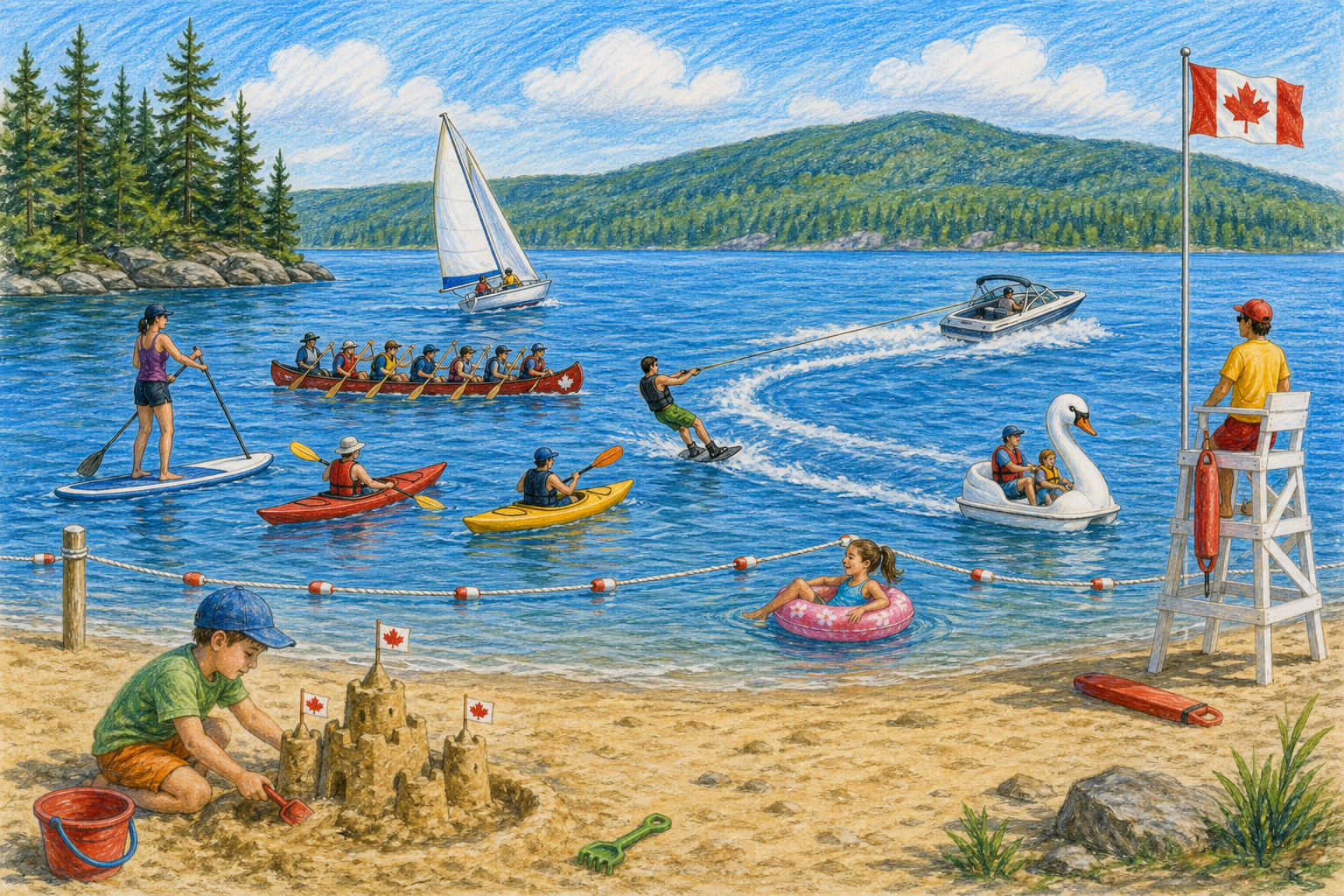
Read the last sentence carefully: the person you’re speaking with cannot see the picture. Imagine you’re describing it to a friend on the phone. Don’t take anything for granted. Say where things are, what they look like and what people are doing, and be as descriptive as you can.
The answer at a glance
Before we go into detail, here’s the whole shape of a good Task 3 answer. Every part is explained below.
| Part | What you say |
|---|---|
| Overview | In this picture, I can see [what, when, where]. |
| Detail 1–5 | On the left / In the foreground / In the background… [one thing you prepared] |
| Describe | Number, colour, size, what they’re doing |
| Wrap-up (only with 5+ seconds left) | These are just a few of the things I can see in this picture. |
The first line is your overview: a one-sentence summary of the whole picture. Then you describe five things, saying where each one is. Finally, a short wrap-up if you have time.
That’s it. Now let’s go through each part.
1. Preparation and note-taking
You have 30 seconds to look at a busy picture and plan 60 seconds of speaking. Do it in two steps.
Step 1: Make an overview
An overview is a one-sentence summary of everything you can see. To make one, answer three questions:
- What is happening? A lot of people are enjoying the water.
- When is it? During the day, in summer.
- Where is it? At a beach by a lake.
Put them together, and that’s your overview:
A busy beach by a lake on a sunny summer day.
Step 2: Choose five things that are easy to describe
Next, pick five things in the picture. Five is about how many descriptions you need to reach 60 seconds.
Choose things that are easy to describe. The easiest features are:
| Easy feature | Example from our picture |
|---|---|
| Numbers | Eight people are paddling a long canoe. |
| Colours | There’s a red kayak and a yellow kayak. |
| Sizes | There’s a small white sailboat and a huge green hill. |
| Shapes | There’s a pedal boat shaped like a swan. |
This doesn’t mean you should only describe numbers and colours. If you can describe the harder parts of the picture, go ahead: the point is to show the rater how well you can describe it. But if something feels too hard to explain, replace it with one of these easy features.
Avoid what you can’t say
There are two kinds of things to avoid.
1. Things that are difficult to explain. Some parts of a picture take complex language to describe. For example: “The water-skier is being pulled by a rope attached to the motorboat, which is leaving a curved trail of foam behind it.” That’s a lot of difficult grammar and vocabulary for one detail. Many learners would get lost halfway through, so choose something simpler instead.
2. Things that involve words you don’t know. If you see something and know the word in your own language but not in English, leave it out.
In our picture, there’s a rope with red and white floats that marks the swimming area. Do you know the English word for those floats? If not, you have two options:
- Skip it. There’s plenty more to describe.
- Work around it. “There’s a long rope on the water that shows where people can swim.”
Don’t surprise yourself. The worst thing that can happen in this task is starting a sentence and realizing halfway through that you don’t know the word, while the timer keeps running. That’s very stressful, and it’s easy to avoid: decide in your preparation time what you will and won’t describe.
How to write your notes
- Keywords only. You don’t have time for sentences.
- Write where each thing is: left, right, front, back, middle. Then you won’t have to search the picture again while you speak.
- Keep the picture in front of you. You can still look at it while you speak, so your notes only need to remind you of your plan.
Your notes for our picture could look like this:
Practice: an overview and five things for two new pictures
Set a 30-second timer for each picture. Write one overview, then five things with their location. Then compare with the sample notes.
1.
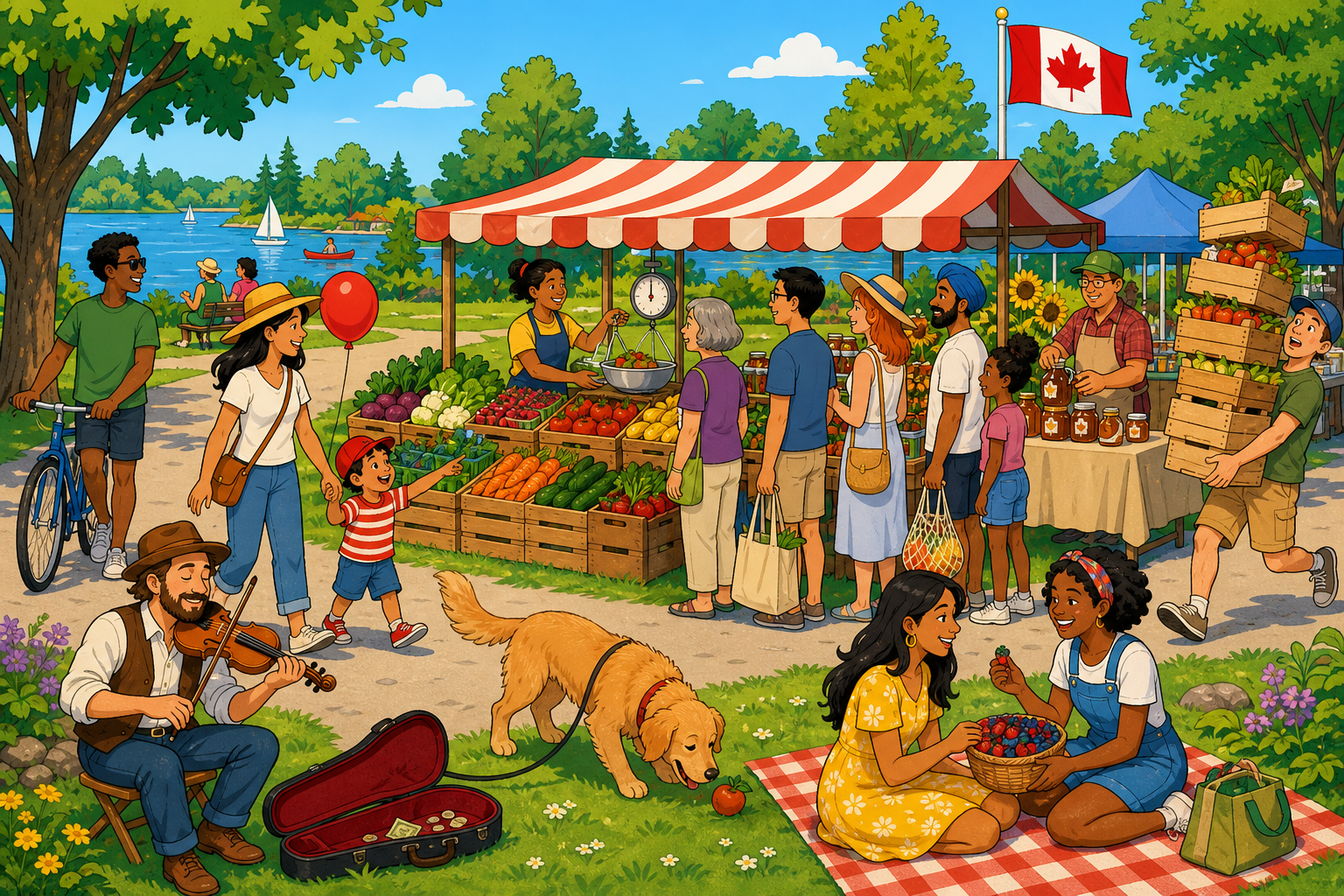
- Overview: outdoor market in a park, sunny summer day
- Middle: red and white striped stall, lots of vegetables
- Left: man playing violin, case open on the ground
- Front: golden dog, sniffing an apple
- Right: two women, picnic, red checked blanket
- Far: lake, small sailboat
2.
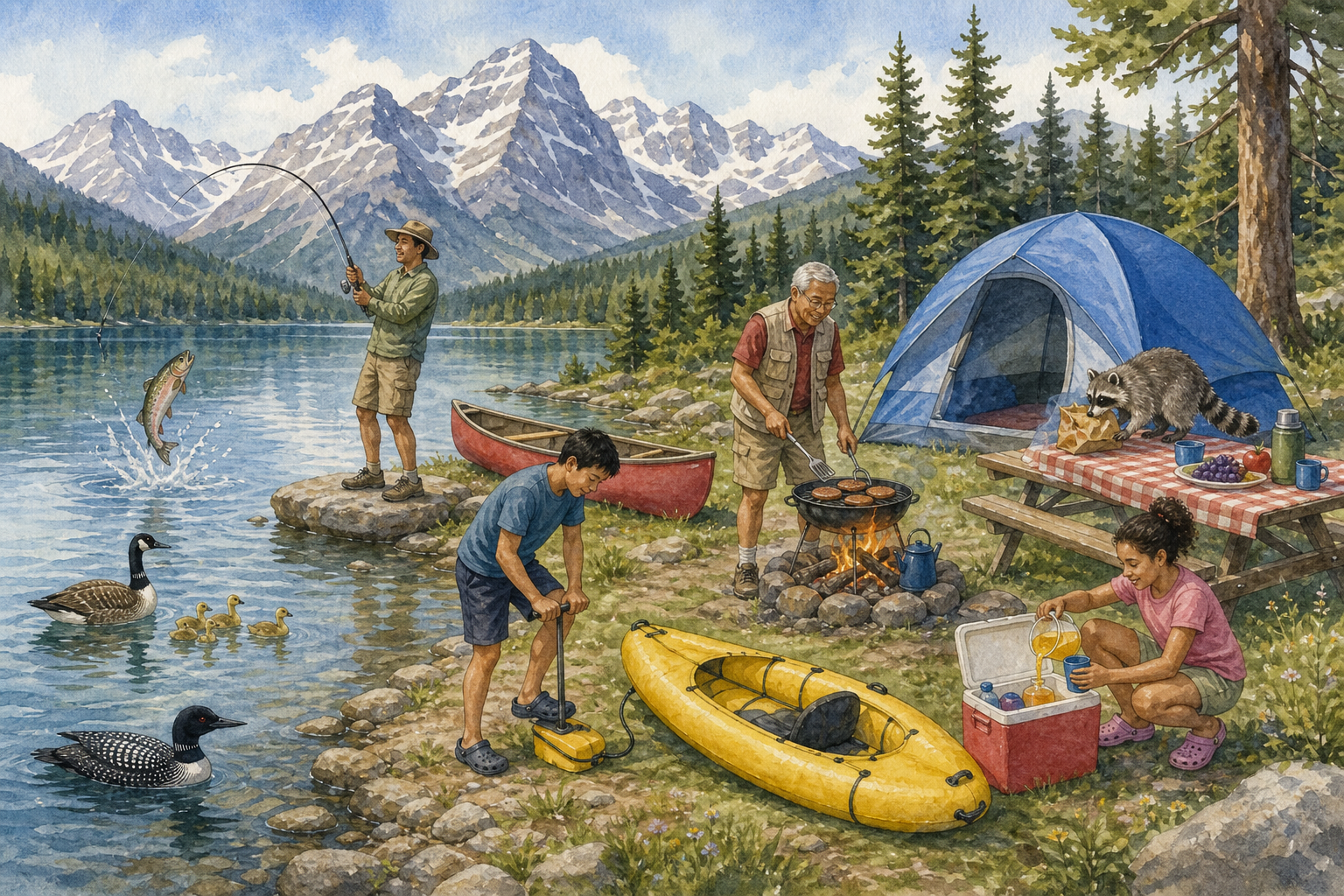
- Overview: family camping by a lake, mountains, daytime
- Left: man fishing on a rock, fish jumping
- Middle: boy pumping up yellow kayak
- Right: blue tent, raccoon on picnic table
- Front: girl, red cooler
- Far: snowy mountains
Recap: Make a one-sentence overview (what, when, where). Choose five easy things to describe, and skip anything you can’t say in English. Write keywords and where each thing is.
2. The template
Now we turn the notes into an organized description that’s clear and easy to follow. Here’s each part of the template, in order.
Overview
In this picture, I can see a busy beach by a lake on a sunny summer day.
Start with your overview, so the listener can imagine the whole scene before you go into detail.
Describe your five things
Now describe the five things you prepared. Start each one by saying where it is, so the listener knows where to “look”:
| Where | Phrase |
|---|---|
| Left or right | On the left / On the right-hand side, I can see… |
| Top or bottom | At the top / At the bottom of the picture, there is / there are… |
| Front | In the foreground, I can see… |
| Back | In the background, there is / there are… |
| Anywhere | Another thing I can see in this picture is… |
| Small details | If you look closely / carefully, you can see… |
Notice: it’s at the top of the picture, not on the top.
Then describe each thing: how many, what colour, how big, and what the people are doing.
On the left, I can see a woman standing on a paddleboard. Another thing I can see in this picture is two people paddling kayaks: one red and one yellow.
Use any order that makes sense. Two easy orders are front to back (foreground, then background) or left to right. What matters is that you don’t jump around randomly.
Wrap-up
These are just a few of the things I can see in this picture.
Only use it if you have five seconds or more left.
- 5 seconds or more left? Say the wrap-up.
- Less than 5 seconds? Skip it. Keep describing and let the time run out.
Save the template phrases
9 phrasesHow to use these: each phrase is ready to use in your writing or speaking. Replace the purple part with your own details. Tap the bookmark to save a phrase to Saved Words (free account), so you can review it before your test and use it in your practice.
In this picture, I can see overview.
On the left, I can see something.
On the right-hand side, there is something.
At the top of the picture, there are things.
In the foreground, I can see something.
In the background, there is something.
Another thing I can see in this picture is something.
If you look closely, you can see something.
These are just a few of the things I can see in this picture.
Quick practice: use the template
Try the template before you add any useful phrases. The recorder below gives you the real 30 seconds to look at the picture, then 60 seconds to speak. Make an overview, choose five easy things, and follow the template. Don’t worry about sounding fancy yet: the goal is a clear, organized description.
Listen to your recording: did you follow the order of the template? Then read on, because useful phrases are what take the same answer to the next level.
Recap: Overview → five things, each starting with where it is → wrap-up, only if you have 5+ seconds left.
3. Useful phrases
Useful phrases are expressions that suit the task perfectly: here, phrases for describing a picture. Using a variety of them shows the rater a wider range of vocabulary, which can raise your score.
Why these phrases? They’re natural, spoken English: common collocations and expressions that suit this task, not big written words. Learn more in Vocabulary That Lifts Your Level.
They come in three groups: phrases that say where something is, phrases that describe what’s happening, and phrases that guess what you can’t see for sure.
Here are seventeen of them at a glance:
| Useful phrase | Example |
|---|---|
| up close / in the far distance | In the far distance, there’s a white sailboat. |
| In the middle of the picture,… | In the middle of the picture, a girl is floating in a swim ring. |
| Right next to / Just behind… | Right next to the sandcastle, there’s a red bucket. |
| …can be seen + -ing | A boy can be seen building a sandcastle. |
| …is about to + verb | The boy is about to put a flag on the castle. |
| What really stands out is… | What really stands out is the swan-shaped boat. |
| This gives me the impression that… | This gives me the impression that it’s a holiday. |
| …looks as if… | The boy looks as if he’s proud of his castle. |
| apparently | The lifeguard is apparently watching the swimmers. |
| …seems to be… | The girl seems to be having fun. |
| …looks like… | The man looks like he’s about to fall. |
| …appears to be… | The family appears to be enjoying the ride. |
| maybe / perhaps | Perhaps they’re on vacation. |
| It’s possible that… | It’s possible that the canoe is part of a race. |
| It’s likely that… | It’s likely that the beach is very busy all summer. |
| Judging by…,… | Judging by the clear sky, it’s a hot day. |
| It must be… | It must be a weekend. |
Tap the bookmark on any phrase below to save it to your Saved phrases library, so you can review it before your test. Now let’s look at each one.
Picture, image, photo
First, a small one: picture, image and photo mean the same thing here. Switch between them so you don’t repeat the same word: In this picture… If you look closely at the image…
Where things are
Up close / in the far distance
These mean the same as in the foreground and in the background. They give you more ways to say where things are.
- “Up close, a boy is building a sandcastle.”
- “In the far distance, I can see a small white sailboat.”
Save these phrases
2 phrasesHow to use these: each phrase is ready to use in your writing or speaking. Replace the purple part with your own details. Tap the bookmark to save a phrase to Saved Words (free account), so you can review it before your test and use it in your practice.
Up close, someone is doing something.
In the far distance, there is something.
In the middle of the picture
For things that are neither left nor right, front nor back.
- “In the middle of the picture, a girl is floating in a pink swim ring.”
Save these phrases
1 phraseHow to use these: each phrase is ready to use in your writing or speaking. Replace the purple part with your own details. Tap the bookmark to save a phrase to Saved Words (free account), so you can review it before your test and use it in your practice.
In the middle of the picture, there is something.
Right next to… / Just behind…
Use these to describe one thing in relation to another. It’s a great way to move from one detail to the next without saying “another thing I can see” again.
- “Right next to the sandcastle, there’s a red bucket.”
- “Just behind the kayaks, I can see eight people paddling a long canoe.”
Save these phrases
2 phrasesHow to use these: each phrase is ready to use in your writing or speaking. Replace the purple part with your own details. Tap the bookmark to save a phrase to Saved Words (free account), so you can review it before your test and use it in your practice.
Right next to something, there is something.
Just behind something, I can see something.
What’s happening
…can be seen + -ing
A more formal way to say someone is doing something. It adds variety to there is and I can see.
- “A young boy can be seen building a sandcastle.”
- “A man can be seen water-skiing behind a motorboat.”
Save these phrases
1 phraseHow to use these: each phrase is ready to use in your writing or speaking. Replace the purple part with your own details. Tap the bookmark to save a phrase to Saved Words (free account), so you can review it before your test and use it in your practice.
Someone can be seen doing something.
…is about to + verb
Use this for something that’s going to happen in a second. It shows you’re reading the picture closely.
- “The boy is about to put another flag on the sandcastle.”
Save these phrases
1 phraseHow to use these: each phrase is ready to use in your writing or speaking. Replace the purple part with your own details. Tap the bookmark to save a phrase to Saved Words (free account), so you can review it before your test and use it in your practice.
Someone is about to do something.
What really stands out is…
Use this for the most eye-catching thing in the picture.
- “What really stands out is the pedal boat, because it’s shaped like a big white swan.”
Save these phrases
1 phraseHow to use these: each phrase is ready to use in your writing or speaking. Replace the purple part with your own details. Tap the bookmark to save a phrase to Saved Words (free account), so you can review it before your test and use it in your practice.
What really stands out is something.
Guessing what you can’t see for sure
A picture doesn’t tell you everything. You can’t know for sure how people feel, why they’re there or what will happen next. These phrases let you guess, and guessing well shows a wide range of language.
This gives me the impression that…
Use this when you interpret the picture: you say something you can’t see, based on what you can see.
- “Everyone is wearing summer clothes. This gives me the impression that it’s a very hot day.”
We don’t see the temperature in the picture, but it’s a reasonable guess from the evidence.
Save these phrases
1 phraseHow to use these: each phrase is ready to use in your writing or speaking. Replace the purple part with your own details. Tap the bookmark to save a phrase to Saved Words (free account), so you can review it before your test and use it in your practice.
This gives me the impression that your guess.
…looks as if…
- “The boy looks as if he’s really proud of his sandcastle.”
We’re not sure he’s proud, but that’s what the picture suggests.
Save these phrases
1 phraseHow to use these: each phrase is ready to use in your writing or speaking. Replace the purple part with your own details. Tap the bookmark to save a phrase to Saved Words (free account), so you can review it before your test and use it in your practice.
Someone looks as if he or she is feeling something.
apparently
- “The lifeguard is apparently watching the swimmers.”
Apparently means “this is what it seems like, but I’m not sure.”
Save these phrases
1 phraseHow to use these: each phrase is ready to use in your writing or speaking. Replace the purple part with your own details. Tap the bookmark to save a phrase to Saved Words (free account), so you can review it before your test and use it in your practice.
Someone is apparently doing something.
…seems to be… / …looks like… / …appears to be…
Three more ways to say this is how it seems:
- “The girl in the swim ring seems to be having a great time.”
- “The water-skier looks like he’s about to fall.”
- “The family in the swan boat appears to be very relaxed.”
You can also use what appears to be when you’re not sure what something is: “In the far distance, there’s what appears to be a small island.”
Save these phrases
1 phraseHow to use these: each phrase is ready to use in your writing or speaking. Replace the purple part with your own details. Tap the bookmark to save a phrase to Saved Words (free account), so you can review it before your test and use it in your practice.
Someone seems to be doing something.
Save these phrases
1 phraseHow to use these: each phrase is ready to use in your writing or speaking. Replace the purple part with your own details. Tap the bookmark to save a phrase to Saved Words (free account), so you can review it before your test and use it in your practice.
Someone looks like he or she is about to do something.
Save these phrases
2 phrasesHow to use these: each phrase is ready to use in your writing or speaking. Replace the purple part with your own details. Tap the bookmark to save a phrase to Saved Words (free account), so you can review it before your test and use it in your practice.
Someone appears to be feeling something.
What appears to be something.
Maybe / perhaps
For a simple guess (speculation):
- “Maybe the people in the canoe are training for a race.”
- “Perhaps they’re on summer vacation.”
Save these phrases
2 phrasesHow to use these: each phrase is ready to use in your writing or speaking. Replace the purple part with your own details. Tap the bookmark to save a phrase to Saved Words (free account), so you can review it before your test and use it in your practice.
Maybe someone wants to do something.
Perhaps someone is feeling something.
It’s possible that… / It’s likely that…
Possible is a weaker guess; likely is a stronger one.
- “It’s possible that the canoe is part of a summer camp.”
- “It’s likely that the beach is this busy every weekend.”
Save these phrases
2 phrasesHow to use these: each phrase is ready to use in your writing or speaking. Replace the purple part with your own details. Tap the bookmark to save a phrase to Saved Words (free account), so you can review it before your test and use it in your practice.
It's possible that your guess.
It's likely that your guess.
Judging by…
This one gives your guess and your evidence in one sentence.
- “Judging by the clear blue sky, it’s a perfect day for the beach.”
Save these phrases
1 phraseHow to use these: each phrase is ready to use in your writing or speaking. Replace the purple part with your own details. Tap the bookmark to save a phrase to Saved Words (free account), so you can review it before your test and use it in your practice.
Judging by a clue, your guess.
It must be…
Use must be when you’re almost sure.
- “So many people are at the beach. It must be a weekend or a holiday.”
Save these phrases
1 phraseHow to use these: each phrase is ready to use in your writing or speaking. Replace the purple part with your own details. Tap the bookmark to save a phrase to Saved Words (free account), so you can review it before your test and use it in your practice.
It must be your guess.
How many should you use? Try to use three or four different useful phrases in one answer, including at least one guess. You don’t need all of them.
One more tip: use the present continuous
This task is about what’s happening right now, in the picture. So use the present continuous (is / are + -ing) as much as you can.
| ✗ | ✓ |
|---|---|
| A boy builds a sandcastle. | A boy is building a sandcastle. |
| Two people paddled kayaks. | Two people are paddling kayaks. |
Recap: Use the present continuous. Mix facts with guesses (seems to be, looks as if), and use three or four different useful phrases.
4. The example answer
Here’s a full answer for our picture. It follows the template and uses some of the useful phrases. Template phrases and useful phrases are in bold.
In this picture, I can see a busy beach by a lake on a sunny summer day.
In the foreground, a young boy in a blue cap can be seen building a sandcastle with small Canadian flags on top. He looks as if he’s really proud of it.
In the middle of the picture, a girl is floating in a pink swim ring, and she seems to be having a great time. On the left, a woman is standing on a paddleboard, and two people are paddling kayaks, one red and one yellow. Just behind them, eight people are paddling a long red canoe together.
On the right-hand side, there’s a lifeguard in a yellow shirt sitting on a tall white chair. If you look closely, you can also see a parent and a child in a pedal boat shaped like a swan.
In the far distance, there’s a small white sailboat and a huge green hill. Judging by the clear blue sky, it must be a hot day.
These are just a few of the things I can see in this picture.
About 60 seconds at a natural pace.
What makes it work:
- It starts with a clear overview: what, when and where.
- It describes five areas of the picture, and says where each one is.
- It uses easy features: numbers (eight people), colours (red, yellow, pink), sizes (small, huge) and shapes (shaped like a swan).
- It skips the floating rope, which needs difficult vocabulary.
- It uses the present continuous all the way through.
- It mixes facts with guesses: looks as if, seems to be, must be.
More example answers
The same template works for every Task 3 picture. These three answers show it with an indoor scene, a scene with a lot going on, and a picture full of people. Open the ones you want to see.
Example 2: An indoor scene
Describe some things that are happening in the picture below as well as you can. The person you are speaking with cannot see the picture.
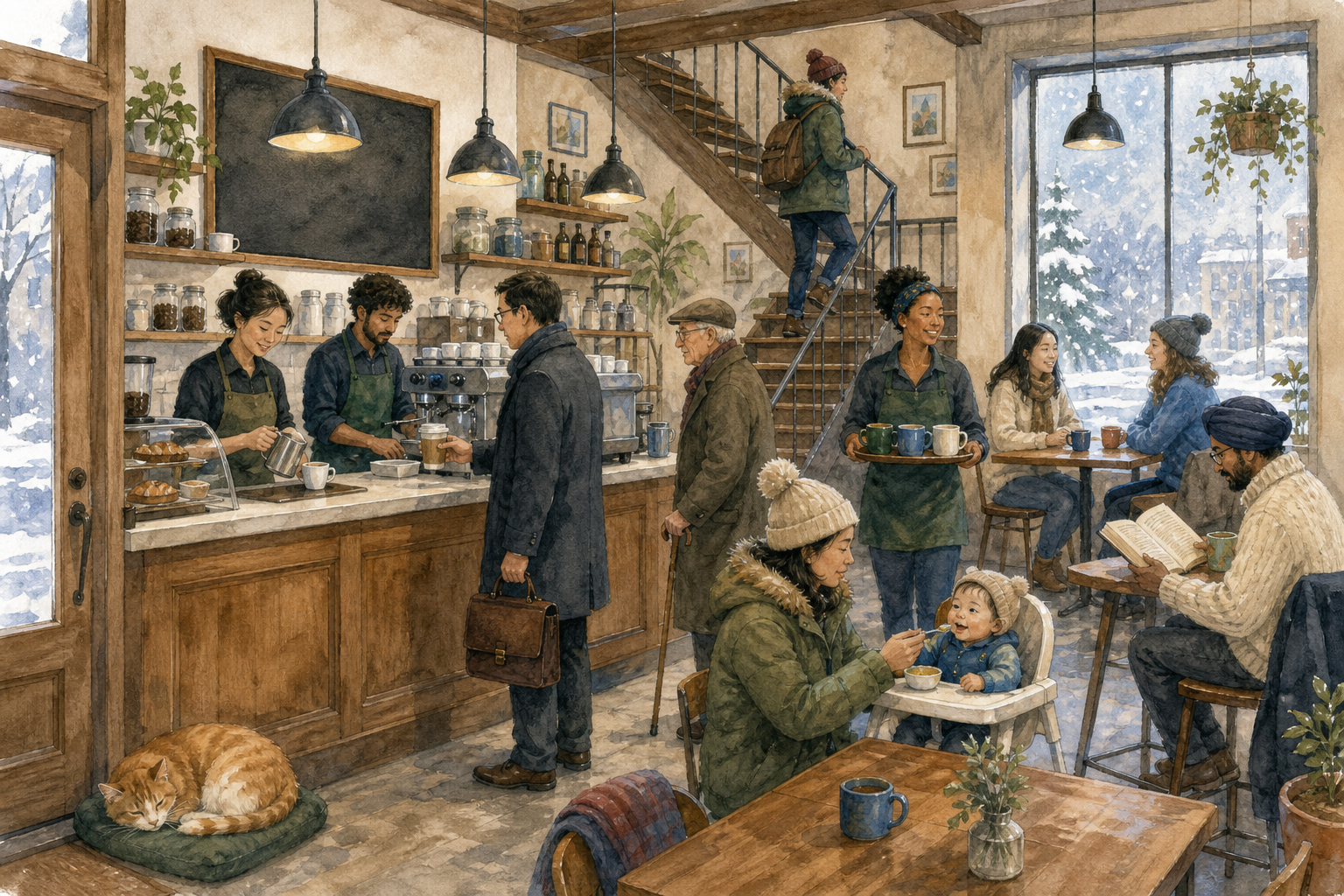
In this picture, I can see a cosy café on a snowy winter day.
On the left, two baristas in green aprons are working behind a wooden counter. One of them is about to hand a coffee to a man in a long dark coat, who’s holding a brown briefcase.
In the middle of the picture, a woman in a white woolly hat is feeding a baby in a high chair, and just behind them, a waitress is carrying a tray full of mugs.
On the right-hand side, a man in a blue turban can be seen reading a book, with a mug on the table next to him.
In the background, two young women are chatting by a big window, and judging by the snow outside, it must be freezing.
What really stands out is an orange cat sleeping on a green cushion by the door, in the bottom left corner.
These are just a few of the things I can see in this picture.
About 60 seconds at a natural pace.
What to notice:
- Indoors, in the background means the back of the room: here, the window.
- The answer ends its details with What really stands out is…, which is a natural way to save something fun for last.
Example 3: A scene with a lot going on
Describe some things that are happening in the picture below as well as you can. The person you are speaking with cannot see the picture.
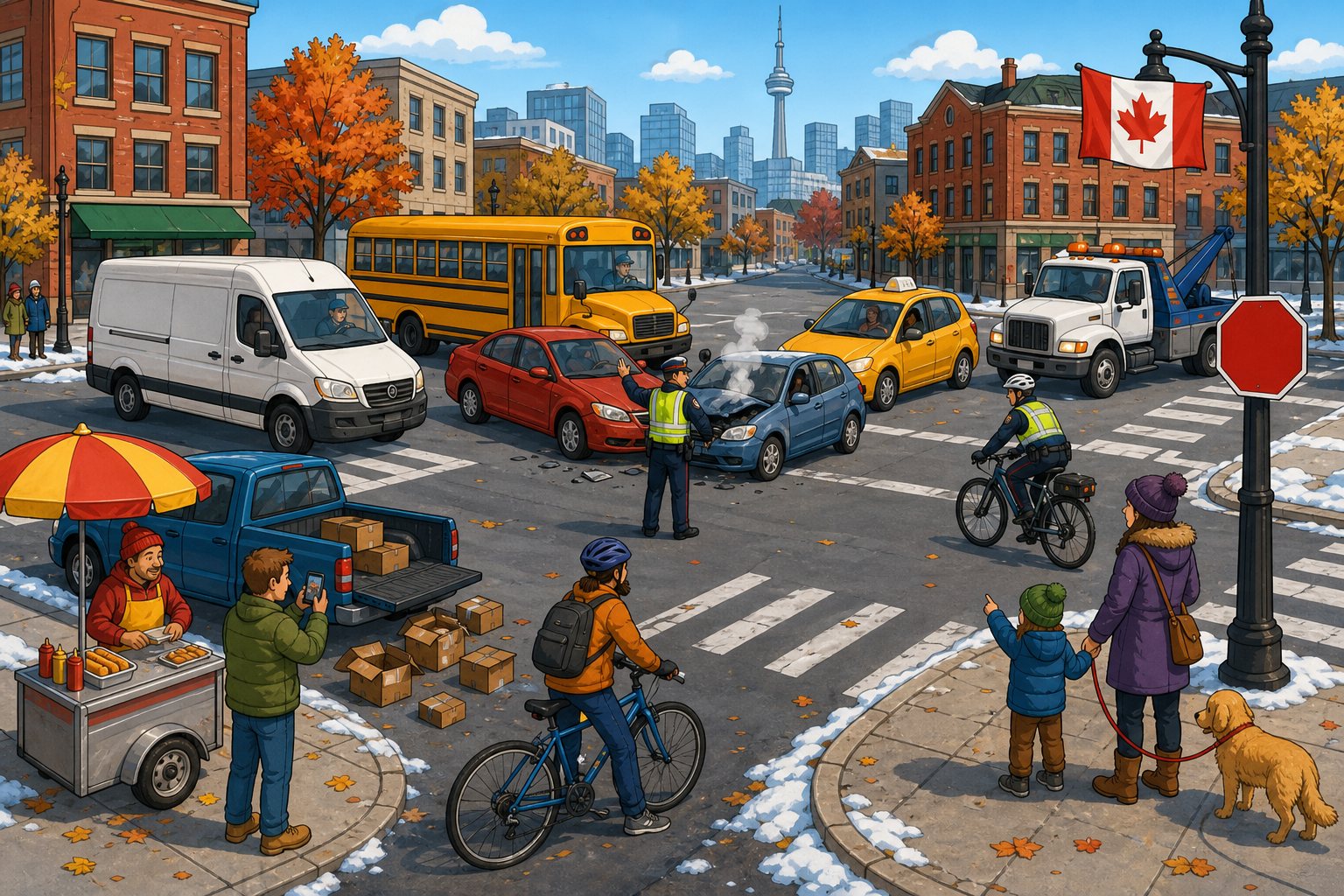
In this picture, I can see a busy city intersection on a fall day, just after a small car accident.
In the middle of the picture, a red car and a blue car have bumped into each other, and there’s steam coming out of the front of the blue car. A police officer in a bright yellow vest is standing right next to them, with one hand up, directing the traffic.
On the right, a white tow truck seems to be arriving, and another officer on a bicycle is riding towards the cars.
On the left, a man in a green jacket is filming everything on his phone. Just behind him, there are cardboard boxes all over the road, which look as if they’ve fallen off a blue pickup truck.
In the bottom right corner, a mother and a little boy are watching, and the boy is pointing at the accident.
These are just a few of the things I can see in this picture.
About 60 seconds at a natural pace.
What to notice:
- There’s far more in this picture than anyone could describe in 60 seconds. The answer picks five things and skips the rest: the hot-dog cart, the school bus, the dog.
- It avoids words that are hard to say quickly. The front of the car works just as well as the hood.
Example 4: A picture full of people
Describe some things that are happening in the picture below as well as you can. The person you are speaking with cannot see the picture.
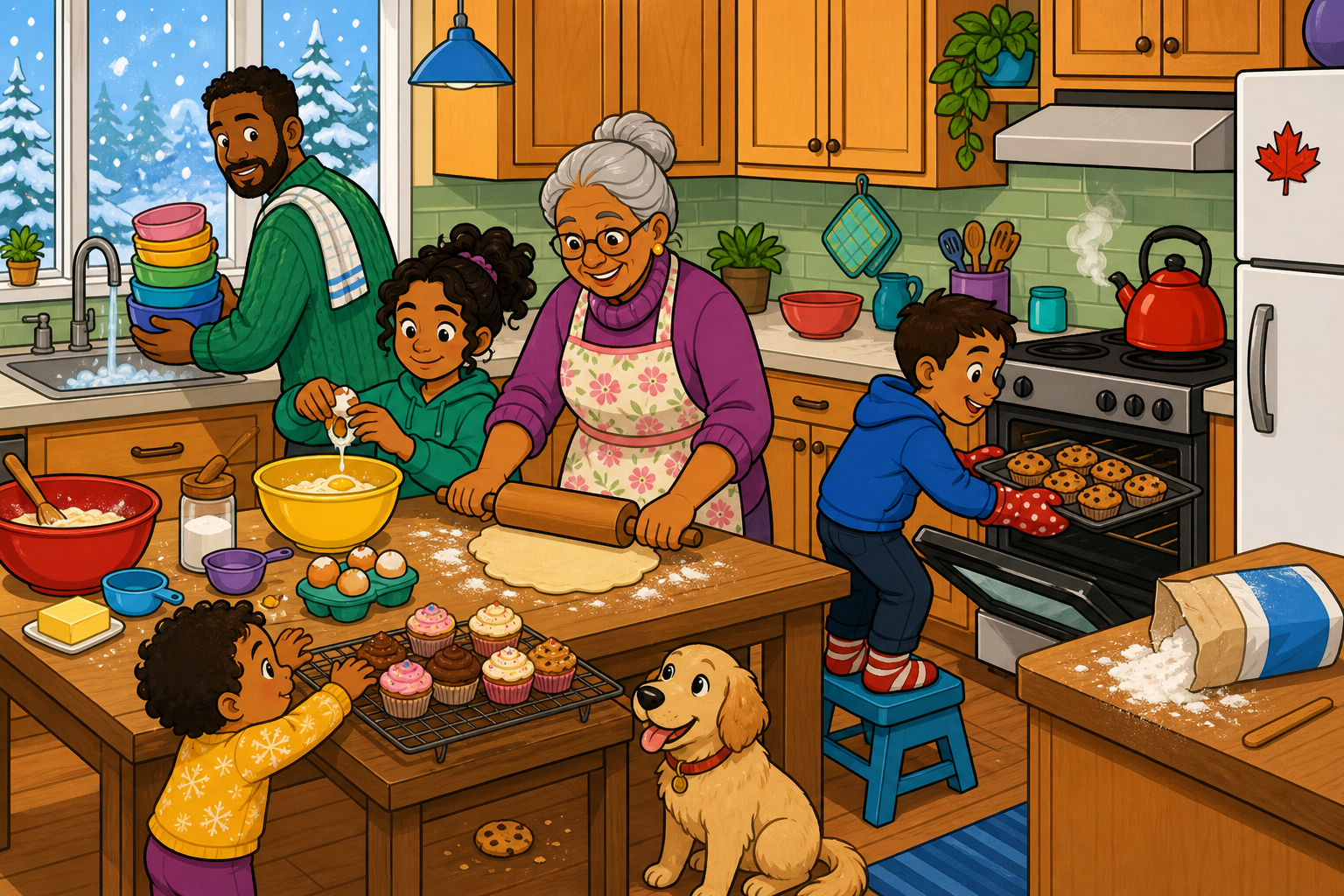
In this picture, I can see a family baking together in a big kitchen on a snowy day.
In the middle of the picture, a grandmother with grey hair and a flowery apron is rolling out dough on a wooden table. Right next to her, a girl in a green sweater is cracking an egg into a yellow bowl.
On the right, a little boy in a blue hoodie is standing on a step stool next to the open oven, holding a tray of muffins.
On the left, a man with a towel over his shoulder can be seen washing a stack of colourful bowls at the sink.
In the foreground, a toddler in a yellow sweater is reaching for some cupcakes, and a golden dog is sitting under the table, staring at a cookie on the floor. It looks like he’s hoping no one notices.
These are just a few of the things I can see in this picture.
About 60 seconds at a natural pace.
What to notice:
- With many people, describe each one the same way: who (a grandmother), what they look like (grey hair, a flowery apron) and what they’re doing (rolling out dough).
- Colours make each person easy to picture: green sweater, blue hoodie, yellow sweater.
Common mistakes
| Mistake | Fix |
|---|---|
| No overview: starting with one small detail | Start with what, when and where |
| A list of objects: “There’s a boat. There’s a tree.” | Add number, colour, size and what people are doing |
| Not saying where things are | Start each detail with on the left, in the foreground… |
| Jumping around the picture randomly | Go front to back, or left to right |
| Starting a sentence you can’t finish | Decide in your prep time what to skip, or work around the word |
| ”A boy builds a sandcastle." | "A boy is building a sandcastle." |
| "On the top of the picture…" | "At the top of the picture…” |
| Rushing the wrap-up with 2 seconds left | Only wrap up with 5+ seconds left |
Practice
You’ve practiced the template on its own. Now describe the same picture again, this time using at least three useful phrases, and compare the two recordings: the second should sound richer.
Describe it again and get AI feedback
Check your recording:
- I started with an overview: what, when and where
- I described five things, and said where each one was
- I used numbers, colours, sizes or shapes
- I used the present continuous
- I used at least three different useful phrases, including a guess
- I only wrapped up if 5+ seconds were left
- I spoke for at least 50 seconds
Open a Task 3 set on Celpora, use the template, and get instant AI feedback on all four scoring areas.
Practice Task 3: Describing a Scene. 30s prep · 60s speaking · AI feedback on all four dimensions




